Today, the Mulefoot
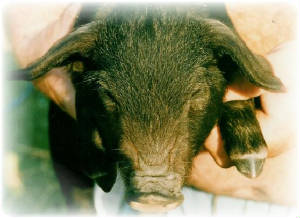
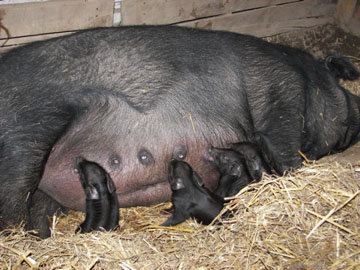
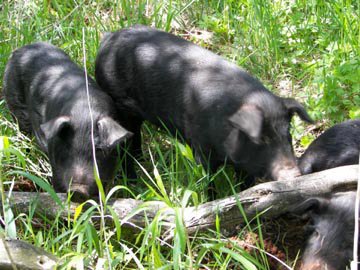
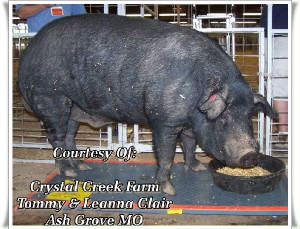
is the rarest of American swine breeds.The most distinctive feature of the American Mulefoot hog is the solid hoof which resembles
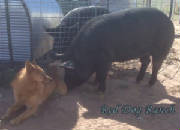
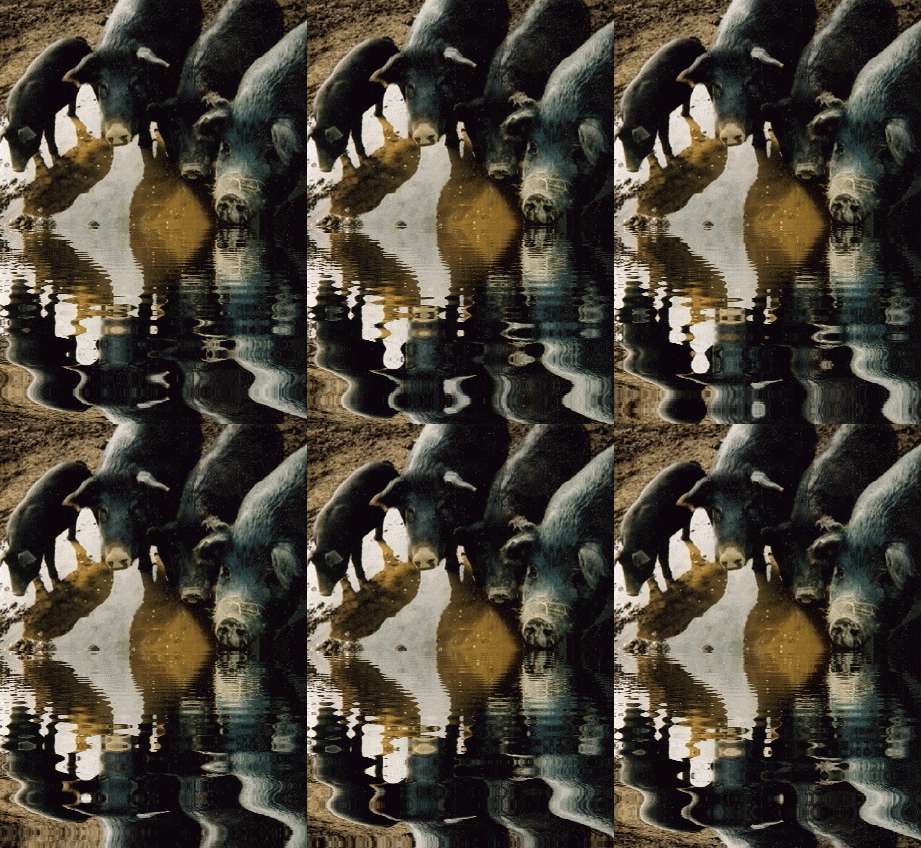
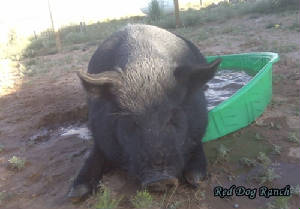
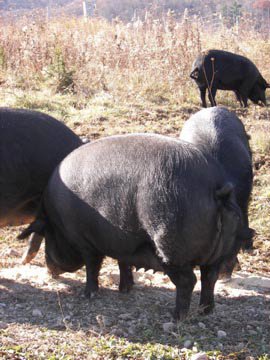
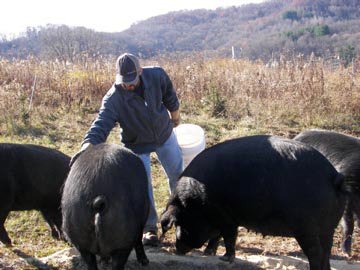
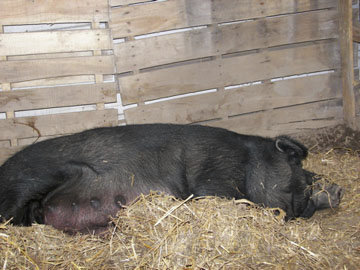
that of a mule. The Mulefoot is a large docile, black hog with sows weighing 250-400 pounds, boars 350-600 pounds. The
American Mulefoot has a documented population with a breed standard and a long history of agricultural use. This breed
is unique to the United States and is critically rare. Recent events, however, have led to more optimism regarding its survival.
Animals favored by modern agribusiness aren’t those happy creatures featured in children’s
books. They’re bred to emphasize marketable features: cows that deliver rivers of milk, for example, and pigs that produce
uniformly large, low-fat pork chops. Other characteristics, such as resistance to disease or tolerance for heat, have been
downplayed, because farmers can compensate with advanced care techniques and medicine. "Through better animal health,
through better medicine and better control of the environment, we in a way obviated the need to breed these animals for hardiness
in resisting negative environmental influences, including disease,". "We have created a very delicate animal."
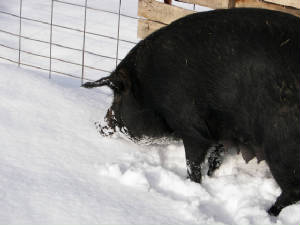
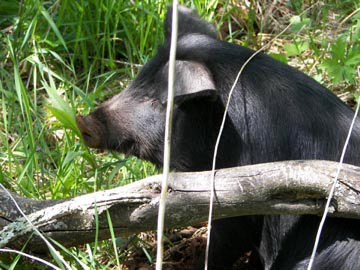
The Mulefoot Pig and other heritage breeds thrive and are a hardy breed. Unlike the commercial
breeds of today. They do not fit the description of "delicate", thus are perfect as a farm addition.
The Mulefoot hog population is classified as Critical by the American Livestock Breeds Conservancy (fewer than 200 in
annual registration). However its outlook is improving. It is now being raised by breeders across the United States. American Livestock Breeds Conservancy.ALBC
Advance reservations accepted by most breeders!
Reserve Early!
Send in reservation form to the breeder closest to you, they will confirm availability
promptly.
ALWAYS state clearly in the note area of pay pal, what payment is for exactly and add your complete
name and address. We print out payment information and add this to your file.
MEMBERS NOTE REGISTRATION UPDATE:Barrows WILL ALWAYS registered FREE of charge-this provides our breeders with a way to
provide documentation to purchasers of the purebred status of the Mulefoot for meat purposes. Members may use the online registration
application for this purpose ONLY. No registrations other than barrows will be accepted at this time via online service. This
will expediate the process for those of you that make a meat sale and want documentation asap. Or you may fax an application
to our fax number: 832-747-4729. Follow up your fax or online registration application with a quick email to: mulefootpigs@aol.com, so we check your submission promptly. We will also be mailing out a "certification of mulefoot pork" form you may fill out
and simply give to purchsers if you like. Further suggestions will be accepted any time.
Mulefoot description..... Coburn describes Mulefoot hogs as mainly black, with occasional
animals having white points; medium flop ears; and a soft hair coat. The hogs were of fairly gentle disposition, fattened
quite easily, and weighed from 400-600 pounds at two years of age. They were considered the highest quality "ham hogs" &
and were fed to great weights before slaughter. For some years breeders claimed that Mulefoots were immune to hog cholera.
That claim has been disproved, though the breed does seem to posses remarkable hardiness.
The National Mulefoot Hog Record association was organized in Indianapolis, Indiana, in January 1908. Two additional
registries were also founded. In 1910 there were 235 breeders registered in twenty-two states. Mulefoots were taken to Canada
between 1900 and 1920 but no attempt was made to establish a herd book and pedigree records were not maintained according
to J.W. MacEwan in The Breeds of Farm Livestock in Canada.
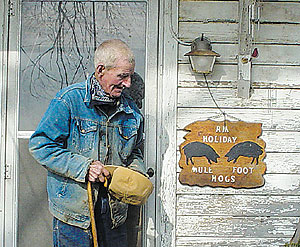
A remnant population of the American Mulefoot has been owned
by R.M. Holiday of Louisiana, Missouri, for nearly forty years. He remembers from boyhood that his family and others raised
these hogs by putting them on islands in the Missouri and Mississippi rivers to forage during the summer and then rounding
them up in the fall for slaughter. This practice was terminated by the Army Corps of Engineers in the 1950's. In 1964 Mr.
Holiday gathered together stock from all the known breeders and established his herd. During 1976 he swapped animals
with a breeder in North Dakota, which introduced some undesirable traits such as prick ears, wattles and split hooves. Nevertheless,
Holliday's strong and consistent production selection has maintained a generally uniform and characteristic herd. After his
experience with this "exotic" animal dealer he sold no more stock except those contracted for slaughter. During these years
the Mulefoot registries folded and all known copies of the herd books were lost.
*A thank you to Mr. R.M. Holliday...
The American Mulefoot Hog was widespread in the central region of the USA in the first half
of this century. They were a hardy outdoor breed with the normal cloven hooves of a pig fused into a single toe (syndactyl).
They were also reputed to be resistant to a number of pig diseases prevalent at the time. By the 1960's vaccines and treatments
were available for most pig diseases and the numbers of Mulefoot Hogs declined. By 1985 only one herd remained belonging to
a Mr R.M. Holliday in Missouri, USA. He continued to maintain the breed because he believed it had a unique characteristic
of hardiness, and because of his own family tradition. Both his father and grandfather had reared this breed of pig on the
small river islands in that part of the Mississippi river from which they would harvest the young pigs. Today, as new resistant
strains of once controllable diseases begin to emerge there is some renewed interest in the American Mulefoot Hogs to re-evaluate
the disease resistance claims. There is also interest in examining the foot structure of the breed to see if it might prevent
lameness in commercial pigs reared on concrete floors or slats. However, if it hadn't been for the determination of this one
farmer to keep this breed going, these new research opportunities would not be available.
Arie McFarlen and Bret Kortie have purchased all of Mr Hollidays stock.
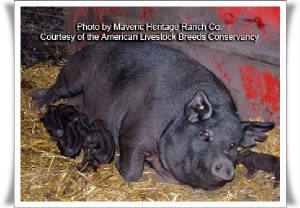
Mr Holiday no longer has any stock available. Maveric Heritage Ranch Co. now have the largest herd of purebred Mulefoots
in the country. We want to extend our sincerest thanks for their dedication to the breed.
Our thoughts and prayers are with Arie and her family. In At 5:30am November
19th, 2008 she lost her 100 year old gambrel barn and with it some of her precious livestock. Arie has been instrumental in
not only the preservation of the Mulefoot breed but others as well. She devotes time, energy and a passion that is appreciated
by all that has had the opportunity to work with her. We are a bit late at getting this up on our page-we were without internet
for a time. We hope all of you support her efforts and offer support, a word of support or cash donation to the Endangered
Hog Foundation be it a $1 or more.
"Arie, we wholeheartedly thank you for your timeless devotion even
in the most trying of times. You are a mentor, and a freind to all that know you."
You can be a part of saving endangered pigs in the US. Support the work of the Endangered
Hog Foundation and Maveric Heritage Ranch through whatever means you can. Be it a cash donation, assistance at the farm, serving
pork from one of our rare breeds, spreading the word or using whatever special talent you have, you are a vital part of our
conservation effort. It takes a village to save a rare breed!
Endangered Hog Foundation - Mission
The EHF mission is to secure & distribute funds to assist breeders in
DNA research, establish breeding protocols, maintain funds for herd rescue, public education, sponsorship of breeding animals
& the importation/exportation of pigs to reinvigorate existing herds in the US, UK & Australia. It was founded by
the owners of Maveric Heritage Ranch Co. Maveric has been working with endangered breeds for 10 years & has come to realize
that the Ranch’s resources would best be utilized in promoting the “Eat it to Save it”® plan & beginning
farmer internships. Maveric will continue to raise endangered pigs & train new farmers, as well as market pork from endangered
pig breeds, including pigs raised at other farms. The Pig Breeds we work to save: Mulefoot, Guinea, Wessex Saddleback, Gloucestershire
Old Spot, Large Black, Red Wattle, Ossabaw Island, Tamworth, & Hereford Hogs. The immediate needs of the Foundation include
the funds to import 10 Wessex Saddleback hogs from Australia to resuscitate the dwindling herd in the US (10 pigs remain).
Additionally, DNA research is desperately needed create breed profiles & work with existing herds to maximize genetic
resources.
Donations can be sent to the “Endangered Hog Foundation” in care of Maveric Heritage Ranch
Co. Visit site to Donate: http://www.maveric9.com/
We have founded The American Mulefoot Hog Association and National Registry. Our associations goal is to document and preserve the American Mulefoot Hog, and save it from extinction.
We are in desperate need of a herd book, participation is crucial for this breeds survival!
We welcome suggestions or information as our goal is giving this special breed new hope, this will be quite and undertaking.
But well worth the end result.
Mr R.M. Holliday
The Origin of the Mulefoot hog.....
The origin of the American
Mulefoot breed is not clear. F.D. Coburn, in his classic 1916 book SWINE IN AMERICA, notes that the Mulefoot hog was found
in Arkansas, Missouri, Iowa, Indiana, across the southwest and in some parts of Mexico. The breed has a well-documented
history over the last century. My personal belief, as well as documented in Swine Science by M.E. Ensminger, B.S., M.A., Ph.D.
Former Manager, U.S.D.A. Dixon Springs Project, Robbs Illinois, Copyright 1961 is that this breed originated in southern ohio.
Members now can pay their yearly dues as well as registration and transfer fees via pay pal online to
ALWAYS state clearly in the note area of pay pal, what payment is for exactly and add your complete name and address.
We print out payment information and add this to your file.
We also are adding an online membership form application, so you may fill out the AMHA membership application online
and pay your dues at the same time. Until this online membership form is available, please send in your membership application
after paying your fee via pay pal.
This will make it much easier for breeders to transfer registrations to new members. The wait time for mailing your
membership application will not apply.
Registration applications as well as registrations for transfer of ownership will still be required to be mailed in to
us. Payment via online is provided as a convenience.
Breeders can now pay for multiple purchasers AMHA membership and registration fees if desired in one transaction.
Enter names of purchaser in the text field of the paypal payment button.